
Пластиковая упаковка «под ключ»
Производство пленки • Производство пакетов • Переработка отходов
Пластиковая упаковка «под ключ»
Производство пленки • Производство пакетов • Переработка отходов
The flexo printing machine is the standard press type for plastic packaging. If you run a bag factory, a film converter, or a pouch producer, you probably already know this. What you need to know is which configuration fits your substrate range, which suppliers have real service infrastructure, and what the real numbers look like on changeover time, ink consumption, and OEE.
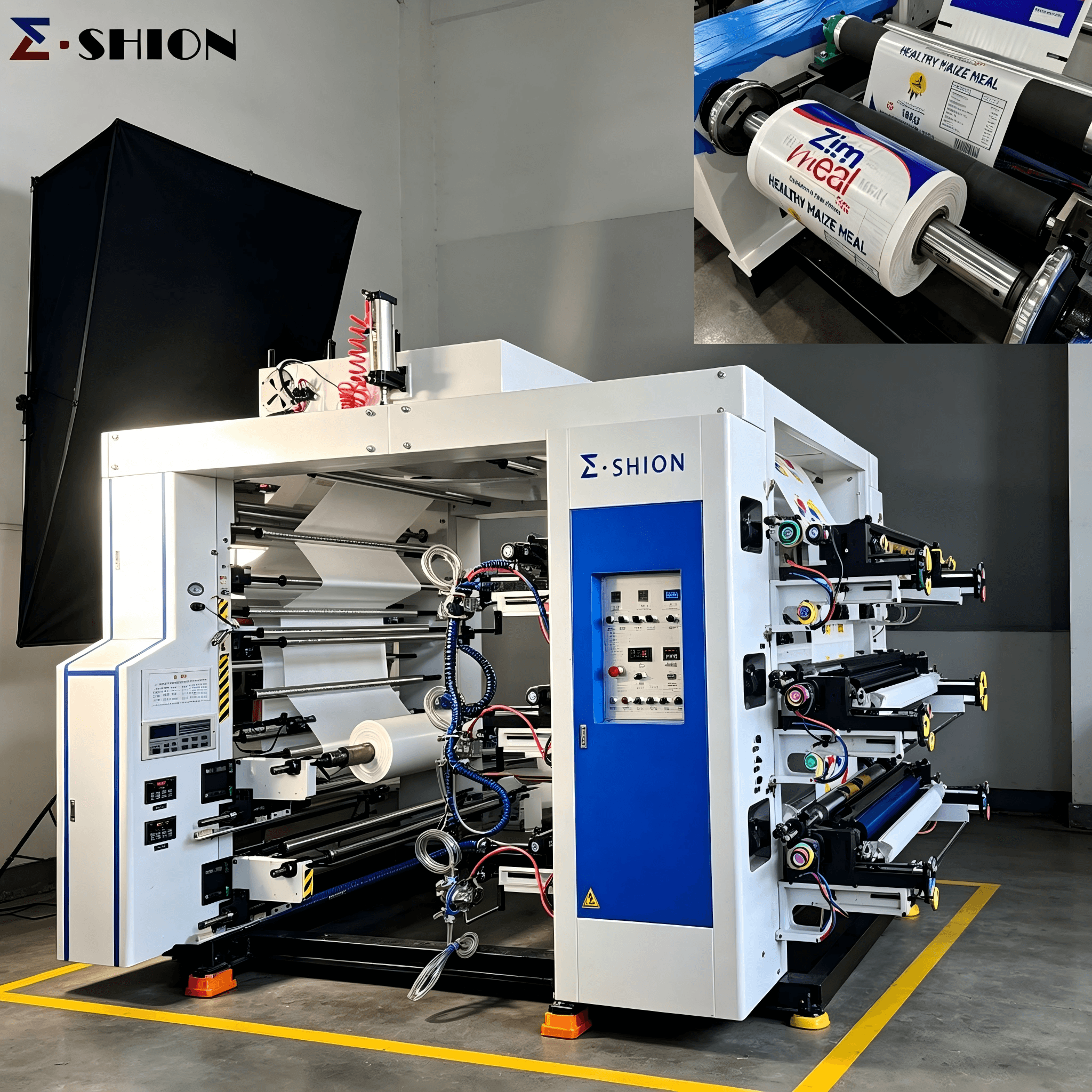
The machine shown above is a YTL6800 6-color флексографская печатная машина with servo-driven register control, LED UV curing, and closed-loop web tension. Configurations like this represent the modern standard for plastic packaging flexo presses in the 6-color mid-web category.
Here is what the market data says. Flexographic printing accounts for roughly 45% of all printing on flexible packaging materials worldwide. The global flexo press market exceeds $20 billion. In plastic film specifically, water-based flexo has largely replaced solvent-based systems because VOC regulations in the EU, North America, and increasingly Southeast Asia make solvent ink systems expensive to operate. Water-based flexo inks meet REACH, California Rule 1131, and similar standards without requiring extensive thermal oxidizer infrastructure.
Speed is the other driver. A mid-web flexo press runs 400 to 2,000 feet per minute. For a 6-color poly bag order running 50,000 pounds of film, that kind of throughput is the difference between hitting a weekly delivery window and missing it.
Before you talk to a supplier, pin down four specs. Getting these wrong creates expensive problems later.
Flexo presses for plastic packaging come in three width ranges:
If you run four-color process, you need four stations minimum. If you run extended gamut (7-color) or add cold foil, white ink, or matte varnish, you add stations. Plan for your most complex job, not your simplest. Adding stations later costs more than buying them upfront.
Plastic films are not paper. They stretch, hold static charge, and have low surface energy. A press designed for paper will cause problems on PE or PP film.
Three things to verify in the spec sheet:
Water-based flexo inks are the default for plastic packaging. They comply with food contact regulations (FDA 21 CFR, EU Regulation 10/2011) when properly formulated and cured, and they avoid the solvent recovery or thermal oxidizer costs that solvent systems carry.
UV LED curable flexo inks are the other option. They cure instantly at the press, eliminate flash point concerns, and extend lamp life to 20,000+ hours versus 1,000 to 2,000 hours for a mercury arc lamp. The tradeoff is higher ink cost per pound and stricter substrate surface energy requirements. You need 42+ dynes/cm on most films for reliable UV ink adhesion.
Hybrid systems—water-based ink with a UV top coat—exist for applications that need both food-contact compliance and chemical resistance, such as detergent packaging or pharmaceutical pouches.
Skip the marketing language. Here is what technology improvements mean in terms of measurable output.
The biggest cost driver on a flexo press is not ink or film—it is downtime. Changeover from one job to the next includes plate mounting, ink filling, impression setting, and color registration. On a press without automation, this routinely takes 2 to 4 hours.
Modern servo-driven presses with auto-plate loading and closed-loop color registration reduce this to 20 to 45 minutes. The difference in annual capacity is significant. A press doing 40 changeovers per week at 3 hours each loses 120 hours per week to changeover. At 45 minutes, that drops to 30 hours. On a 500 FPM press running two shifts, you are talking about millions of linear feet per year.
Specific features to ask about: auto-pasting splicers for continuous unwind (no stopping to splice new rolls), servo impression presets that store job parameters, and camera-based registration that adjusts plate position automatically during the first 50 to 100 yards of a run.
LED UV is now standard on most new presses. The operational benefits are concrete:
If you are specifying a new press, LED UV should be the default unless you have a specific reason to use mercury arc.
A mid-web flexo press with LED UV, auto-registration, and a camera inspection system typically achieves 85% to 95% OEE in a well-run plant. Poorly maintained presses with manual changeovers can run at 60% OEE or below.
Remote monitoring and IoT connectivity on modern presses let your maintenance team see fault codes, drive counts, and production logs in real time. This matters for scheduling preventive maintenance without waiting for a breakdown. Most major manufacturers (Bobst, Windmoeller & Hoelscher, Uteco, Comexi, PCMC) offer some form of this as standard or optional equipment.
Price is the last thing to discuss. Here is the order you should evaluate suppliers:
1. Service response time. Ask: “What is your mean time to response for a mechanical fault on a Saturday?” If the answer is “we will get back to you Monday,” that supplier is not appropriate for a production facility that runs Saturday shifts. Look for 24/7 support with guaranteed on-site response windows.
2. Spare parts inventory. The critical wearing parts on a flexo press—anilox rolls, doctor blades, impression cylinders, servo motors—are not commodity items. Ask whether the supplier keeps these in a regional warehouse or ships from the OEM factory. International air freight on a replacement anilox roll adds 3 to 7 days to your downtime.
3. Print demonstration with your actual film. Any serious supplier will run your substrate on their demo press before you sign. If they cannot or will not do this, walk away. Ink adhesion, corona treatment response, and web tracking behavior vary by film formulation. A press that prints beautifully on standard BOPP may have problems on your specific coextruded film.
4. Customer references in plastic packaging. Ask for three references from companies running the same press model on PE or PP film. Call them. Ask specifically about press reliability, changeover time in practice, and whether the supplier delivered on their service commitments.
To give you a rough reference frame:
Annual maintenance contracts typically run 3% to 6% of purchase price. Budget for this. A $500,000 press should have a $15,000 to $30,000 annual maintenance budget.
The table below summarizes typical flexo printing machine configurations by web width, color count, and target application. Use this as a quick reference when matching a press to your production needs.
| Configuration | Web Width | Color Stations | Типичное применение | Price Range (USD) |
|---|---|---|---|---|
| Narrow-web | 8.5″ to 17″ | 4 to 8 | Labels, small pouches, roll-fed sachets | $60,000 – $150,000 |
| Mid-web | 20″ to 42″ | 4 to 10 | Food bags, overwrap, stand-up pouches, agricultural film | $280,000 – $700,000 |
| Wide-web | 44″ to 80″ | 4 to 12 | Industrial film, shrink film, lamination base film | $900,000 – $2,500,000 |
| Used / refurbished (certified) | Any | Any | Budget-conscious buyers, second-line production | 40% – 60% of new |
These figures are reference pricing for new equipment in 2024. Actual quotes depend on press age, automation level, ink system, and whether installation/commissioning is included. For a deeper comparison of flexo and gravure printing, see our related guide to the gravure printing machine manufacturer market, or review our blown film extrusion machine guide for the upstream film production step.
For additional background on the flexographic printing process, regulatory frameworks, and industry standards, see:
These external resources cover the technical, regulatory, and standards aspects of flexo printing that procurement managers should understand before purchasing a flexo printing machine.
What plastic substrates can a flexo printing machine handle?
PE (LDPE, LLDPE, HDPE), PP (OPP, CPP, BOPP), PET, PETG, nylon (PA), PVC, and coextruded or laminated film structures with EVOH or metalized layers. The press needs the correct unwind tension range, corona treater power, and ink system for each.
What print resolution does a flexo press achieve on plastic film?
65 to 120 lpi is standard. With high-quality photopolymer plates (Cyrel FAST, Toyo Inplate, Asahi AWP), you can reach 150 lpi. That is sufficient for most packaging graphics. If you need finer detail than 150 lpi, offset or digital printing is the alternative.
What does a flexo press cost per hour to run?
For a mid-web press running water-based ink on PE film, typical ink consumption is $0.015 to $0.04 per linear yard, energy is $0.02 to $0.05 per linear yard, and labor is $0.01 to $0.025 per linear yard. Total typically runs $0.05 to $0.12 per linear yard for direct production costs, excluding labor overhead and machine depreciation.
How long does a flexo press last?
With a preventive maintenance program, 15 to 25 years before a major press rebuild. Anilox rolls need replacement or resurfacing every 5 to 10 years depending on volume. Doctor blades are consumables replaced weekly or bi-weekly.
Can a flexo press handle paper and corrugated materials?
Yes. Most presses run paper, paperboard, and corrugated preprint with a tension and impression adjustment. You change plates and ink. The press mechanism does not change. Wide-web corrugated preprint presses and narrow-web label presses are both flexo machines—the substrate changes, the press type does not.
What is the energy consumption of a mid-web flexo press with LED UV?
Approximately 60 to 90 kW during production. A comparable mercury arc press draws 100 to 130 kW. Water-based ink presses without UV curing draw less electricity but require more thermal energy for the dryer section.